AI in IVF in 2026: How Smart Algorithms and Robots Are Reshaping Fertility Care
A couple in a Tier-II Indian city has been trying to conceive for years. Behind the plain fact of “another IVF attempt” is a quiet heartbreak — failed cycles, mounting costs, and an emotional toll that is hard to put into words. This time, in the lab, something is different. An AI watches each embryo develop under a time-lapse camera, learning from hundreds of thousands of past embryos which one is most likely to become a healthy baby. A robotic arm injects a single sperm with micron-level precision. A machine freezes the chosen embryos flawlessly. The embryologist’s judgement is still at the centre — but now amplified by tools that do not tire, do not vary, and see patterns no human eye can catch.
This is the quiet revolution that AI in IVF is bringing to fertility care in 2026. In vitro fertilisation has always turned on tiny margins and human variability, with success rates that have stubbornly hovered around a fifth to a third of cycles. The shift this year is that AI and robotics are attacking exactly those margins — bringing objectivity, consistency, and precision to the most delicate and decisive moments of the IVF process. For a country where infertility affects millions and IVF is moving from the metros into everyday cities, this is transforming a booming field.
This article is about that shift — why IVF has been so hard to improve, how AI and robotics are changing it, and how a fertility clinic in India can embrace it without losing the human care at its heart.
The Core Problem Clinics Face
The central difficulty of IVF is deceptively simple to state and brutally hard to solve: choosing the right embryo. After stimulation, egg retrieval, and fertilisation, a clinic is often left with several embryos and must decide which one to transfer. For decades, that decision has rested on an embryologist visually grading each embryo under a microscope — skilled, careful work, but inevitably subjective, experience-dependent, and variable from day to day. Many embryos that look “normal” simply fail to implant, and no human eye can reliably tell which will.
The consequences land hardest on the couple. Because selection is imperfect, success rates stay low, which means more cycles — each a fresh round of injections, procedures, cost, and emotional strain, with no guarantee at the end. Delicate laboratory steps depend on steady human hands and can vary in ways that quietly affect outcomes. And stimulation protocols have often been one-size-fits-all rather than tailored to the individual. Better tools for these exact moments are what AI in IVF is built to provide.
So the real problem is not “Are our embryologists skilled?” They usually are profound. It is sharper: how do we bring more objectivity, consistency, and precision to the handful of tiny, decisive moments that determine whether a couple goes home with a baby — without losing the human expertise at the centre? Answering that is exactly where AI and robotics now help.
Why This Field Is Transforming Now
Three forces are converging to make this the moment for change.
First, demand is surging, especially in India. With around 27.5 million Indian couples facing infertility and IVF spreading rapidly from metros into Tier II and Tier III cities, far more clinics are performing far more cycles, and the pressure to deliver consistent outcomes has never been greater.
Second, the technology has genuinely matured. Time-lapse incubators now image embryos every few minutes, robotic systems handle micro-scale lab tasks, and AI models trained on huge embryo datasets can predict outcomes. What was once research is now, increasingly, mainstream practice.
Third, the stakes reward precision. Because each cycle is so costly and emotionally draining, even a modest improvement per cycle is enormously valuable to couples. That makes any technology that raises consistency and reduces failed cycles worth serious attention — which is precisely what AI in IVF promises.
Rethinking the Problem: Amplify the Embryologist, Don’t Replace Them
The mistake is to frame this as machines taking over human judgement in the most human of endeavours. That is neither what is happening nor what should be. The right frame is amplification: giving a skilled embryologist objective, data-driven support where human perception is weakest — spotting the embryo most likely to implant, steadying a delicate injection, and freezing at exactly the right parameters.
The shift in 2026 is to let AI and robotics carry the burden of consistency and precision, so the human expert can focus on judgement, care, and the couple. AI can bring objective embryo selection to a decision that used to rely on the naked eye; robotics can steady the hand in the lab’s most delicate steps; and data can personalise a treatment that used to be generic. The reframe is simple: stop treating IVF as a craft limited by human variability, and start amplifying human expertise with tools that make it more consistent — while keeping the embryologist firmly in charge.
How EasyClinic Supports Clinics Embracing AI in IVF
The way EasyClinic fits this is honest and specific: it is not the embryo-selection AI or the lab robot, and it does not touch the science of the cycle. What it does is run the clinic around that science — because an IVF clinic is one of the most administratively demanding operations in medicine, and that complexity, handled badly, undermines even the best lab.
Consider what a single IVF journey involves: weeks of precisely timed appointments, injections, and tests; meticulous records that must never slip; high-value package billing paid over a long cycle; and an emotionally fragile patient who needs constant, compassionate communication. EasyClinic holds all of that in one place — tracking each patient across a long cycle, sending injection and appointment reminders through the patient journey so nothing critical is missed, managing package payments cleanly, and keeping the couple informed and supported throughout. Because it all lives in one clinic management software, the clinic’s team is freed from operational chaos to focus on the medicine and the people. The AI and robots handle precision in the lab; EasyClinic handles precision in the clinic.
The Recent AI in IVF Trends Worth a Clinic’s Attention
Here are the developments actually reshaping fertility care this year.
1. Objective: AI-assisted embryo selection. The flagship shift is AI analysing time-lapse embryo development to predict which embryo is most likely to implant, more consistently than visual grading alone. It supports single-embryo transfer, reducing the risks of multiple pregnancy while protecting the chance of success.
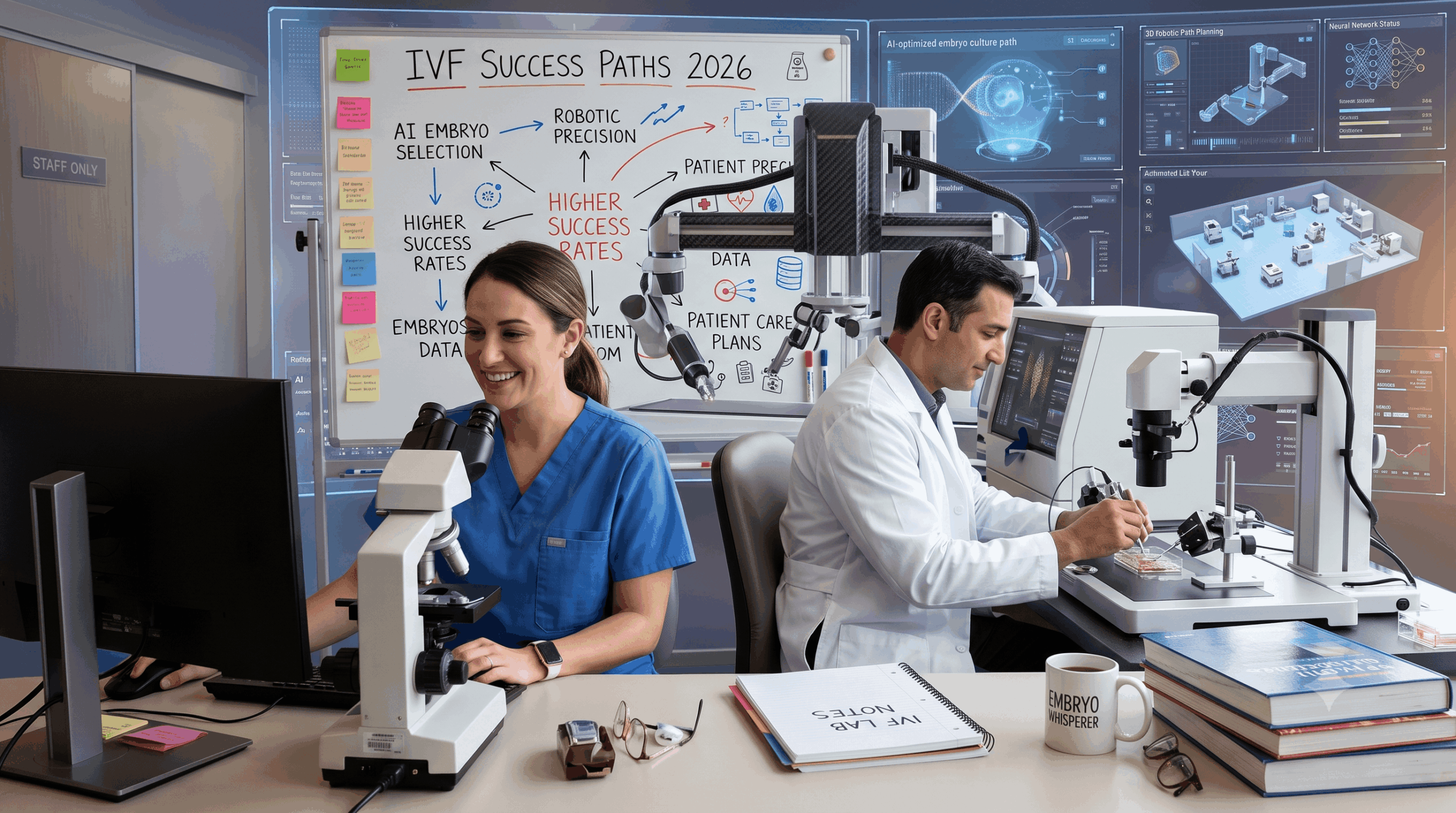
2. Robotic precision in the lab. Robotic arms now perform intracytoplasmic sperm injection with micron-level accuracy, while automated systems handle vitrification and sample transfer in tightly controlled conditions. This strips human variability out of the most delicate, outcome-defining steps.
3. Personalised, AI-guided stimulation. Instead of generic dosing, AI tailors ovarian stimulation to the individual’s biology, aiming to improve egg quality while reducing risks such as ovarian hyperstimulation. Better inputs give every later step a better chance.
4. AI across the whole cycle. The technology now spans stimulation to transfer rather than embryo selection alone, bringing data-driven consistency to the entire journey, with the goal of fewer failed cycles and fewer attempts before success. This whole-cycle role is the heart of modern AI in IVF.
5. Human oversight, validation, and ethics. The essential caveat: these tools amplify embryologists; they do not replace them, and studies show AI can offer more objective assessments while still requiring clinical validation. Genetic testing remains a reference standard where indicated, ethics and India’s ART regulations matter, and results still vary between individuals.
What Clinics Notice After Implementation
The change shows up over cycles, in both outcomes and the confidence of the couples they serve.
| Area of IVF | The “human eye alone” past | With AI and robotics |
|---|---|---|
| Embryo selection | Subjective visual grading | Objective, data-driven support |
| Lab precision | Variable by hand and day | Consistent, robotic accuracy |
| Stimulation | Generic dosing | Personalised to the patient |
| Cycles needed | Often several | Aiming for fewer |
| Consistency | Experience-dependent | Standardised and repeatable |
| The couple’s journey | Repeated, uncertain attempts | More confident, better informed |
The numbers matter, but the outcome clinics value most is simpler: more couples reaching a healthy pregnancy sooner, with fewer heartbreaking cycles along the way.
How the Patient Experience Quietly Improves
For couples, the promise of this technology is deeply personal: a better chance of success and fewer failed cycles before they get there. Each cycle avoided is money saved and, far more importantly, heartbreak spared. Just as importantly, objective, data-backed decisions can bring a measure of transparency and reassurance to a process that often feels frighteningly opaque. None of this replaces the compassion of the clinical team, and none of it should be sold as a guarantee — infertility remains a hard road with no certainties. But a clinic that pairs human care with these tools can offer couples something precious: the sense that every possible advantage is being brought to bear on their hope of a family.
Why EasyClinic Is Built for This Moment
Owners of fertility clinics face a double challenge: the science is advancing at breathtaking speed, and the operational complexity of running IVF is immense. Falling behind on either costs couples their outcomes and clinics their reputation. The practices that thrive pair advanced clinical technology with a system that runs the clinic flawlessly around it.
That is the lane EasyClinic is designed for. It is built for clinics in India, where IVF demand is surging into smaller cities and every long, high-value cycle must be managed with precision and care. By tracking patients across lengthy cycles, sending timely injection and appointment reminders, managing package billing, and supporting compassionate communication throughout — all inside one clinic management software — it lets the clinical team focus on the science and the couple rather than the admin. It does not perform or judge the treatment, which remains firmly with the clinicians and embryologists, and it handles sensitive patient data in line with DPDP and India’s ART record-keeping requirements. The goal is simple: to let a modern fertility clinic run as precisely as the technology now working inside its lab.
10 FAQs Clinic Owners Actually Ask
1. What is AI in IVF, in plain terms? It is the use of artificial intelligence to support fertility treatment — most notably analysing embryo development to help predict which embryo is most likely to implant, and increasingly personalising stimulation. It supports the clinical team’s decisions rather than making them alone.
2. Does AI actually choose the embryo instead of the embryologist? No. AI provides an objective, data-driven assessment, but the embryologist remains in charge of the final decision. The best results come from human expertise and AI working together, not one replacing the other.
3. Does AI genuinely improve IVF success rates? Evidence is promising — AI can assess embryos more objectively and consistently than the eye alone — but it is not a guarantee, and researchers stress that further clinical validation is still needed. Improvement in IVF success rates should be presented honestly, not oversold.
4. What are robotic ICSI and automated vitrification? Robotic ICSI uses a precision robotic arm to inject a single sperm into an egg with micron-level accuracy, and automated vitrification uses a machine to freeze embryos under exact, consistent conditions. Both reduce the human variability in delicate lab steps.
5. Is AI-assisted IVF safe and regulated? It is used as a support tool under clinician oversight, with genetic testing still a reference standard where indicated. Ethics and India’s ART regulations apply, and reputable clinics adopt these tools with validation and care, not as a shortcut.
6. Can this reduce the number of cycles a couple needs? That is a key goal. By improving embryo selection and lab consistency, the aim is fewer failed cycles and fewer attempts before success — sparing couples cost and emotional strain — though outcomes still vary between individuals.
7. How does this support single-embryo transfer? By identifying the single most viable embryo more reliably, AI supports transferring one embryo instead of several, reducing the risks of multiple pregnancy while protecting the chance of a healthy birth.
8. Is this technology available in India, including smaller cities? Increasingly, yes. IVF and these technologies are expanding well beyond the metros into Tier II and Tier III cities, making advanced fertility care more widely available across the country.
9. How does a clinic manage the huge admin of running IVF? This is where a strong clinic management software is essential — tracking long cycles, sending injection and appointment reminders, handling package billing, and supporting patient communication, so the team can focus on the medicine rather than drowning in coordination.
10. Where should a fertility clinic start? Start by getting the operational foundation solid — reliable cycle tracking, reminders, billing, and communication — while evaluating validated AI and lab technologies carefully, with clinician oversight and honest expectations for patients.
Conclusion
IVF has always been a field of small margins and large hopes, where a single subjective decision under a microscope could determine whether a couple became a family. In 2026, AI and robotics are bringing objectivity, consistency, and precision to exactly those decisive moments — not by replacing the embryologist, but by amplifying their expertise. That is what AI in IVF delivers: more objective embryo selection, robotic steadiness in the lab, personalised treatment, and the real prospect of fewer failed cycles for couples who have already endured too many.
Clinics that understand this embrace the technology while keeping human care and honest expectations at the centre. The result is not a cold, mechanised path to parenthood. It is a more precise and more hopeful one — where advanced tools do the work of consistency and precision, skilled humans do the work of judgement and compassion, and more couples are given their best chance at the family they long for.
Take the Next Step
If your fertility clinic wants to run as precisely as the technology inside its lab, see how EasyClinic manages long IVF cycles, reminders, billing, and patient communication in one connected system — and explore the platform built for everyday clinics when you are ready to begin.