1. Click Driven Introduction: Eye Clinics Are at a Turning Point
AI-powered clinics are no longer an idea of the future. In 2026, they will become the new standard. Across healthcare, appointment calls are disappearing, front desks are shrinking, and intelligent systems are taking over patient communication. In ophthalmology, where follow-ups, medication reminders, and repeat visits are critical, this shift is happening faster than most clinics expected.
In India alone, eye care demand is rising sharply due to ageing populations, increased screen exposure, diabetes related vision issues, and urban lifestyle changes. At the same time, clinics are facing staff shortages, higher patient expectations, and mounting compliance pressure. Patients now expect instant responses, online scheduling, and reminders without chasing clinics repeatedly.
Globally, AI chatbots for ophthalmology clinics are quietly replacing manual phone-based workflows. Virtual assistants for eye care clinics now handle appointment booking, answer routine questions, and send automated medication reminders around the clock. Clinics that fail to adopt this shift risk falling behind tech-enabled competitors.
AI-powered clinic management platforms like EasyClinic are at the centre of this transformation, helping eye clinics automate patient support while improving efficiency, accuracy, and care continuity. The question is no longer whether AI will change ophthalmology clinics in India. The real question is whether clinics are ready to adapt in time.
2. Recent Robotic and AI Automation Trends in Ophthalmology in 2026
Ophthalmology is one of the fastest-evolving specialities when it comes to AI-driven automation. In 2026, clinics will no longer use AI only for diagnostics. They are integrating it deeply into patient communication and operational workflows.
AI and Automation Trends Reshaping Eye Clinics
| Trend Area | What Is Changing in 2026 | Impact on Ophthalmology Clinics |
| AI Chatbots for Patient Support | Conversational AI handles appointment booking, FAQs, and follow-ups | Reduced front desk workload and faster patient responses |
| Virtual Assistants for Eye Care Clinics | Voice and text assistants manage reminders and pre-visit instructions | Improved medication adherence and follow-up rates |
| Automated Appointment Scheduling | AI optimises schedules based on visit type and urgency | Fewer no-shows and better doctor time utilisation |
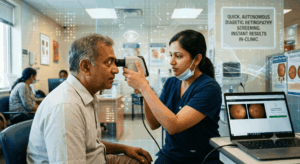
| AI Assisted Diagnostics | AI flags abnormalities in retinal scans and imaging | Faster triage and improved diagnostic accuracy |
| Predictive Analytics | Systems predict follow-up needs and patient drop-off risk | Better long-term patient management |
| Robotics in Eye Surgery | Precision robots assist in cataract and retinal procedures | Higher surgical accuracy and consistency |
| EMR Integrated Automation | Chatbots directly connected to EMRs | Seamless patient journey without data duplication |
These trends show one clear pattern. Automation is no longer optional. It is becoming foundational to how ophthalmology clinics operate.
3. Why Ophthalmology Clinics in India Are Under Pressure Right Now
Ophthalmology clinics in India are under immense pressure from multiple directions. Patient volumes are increasing year after year, but operational capacity is not growing at the same pace. Many clinics are still dependent on manual appointment calls, WhatsApp follow-ups, and paper-based workflows.
Staff shortages are one of the biggest challenges. Trained front desk staff are hard to retain, and doctors are increasingly burdened with administrative tasks that take time away from patient care. Compliance requirements around digital records, data privacy, and reporting add another layer of complexity.
Patients, on the other hand, are changing fast. They expect instant appointment confirmations, reminders before visits, digital prescriptions, and easy communication channels. Clinics that fail to meet these expectations are quickly seen as outdated.
AI-powered platforms like EasyClinic are helping clinics modernise without disrupting daily operations. By introducing AI chatbots for ophthalmology clinics and automated patient support, clinics can handle higher patient loads without increasing staff stress.
4. The Biggest Operational Problems Holding Ophthalmology Clinics Back
Despite medical expertise, many eye clinics struggle with the same operational bottlenecks.
Manual scheduling remains a major pain point. Front desks are flooded with calls, leading to missed appointments, long hold times, and frustrated patients. Fragmented patient records make it difficult to track follow-ups, especially for chronic eye conditions that require long-term monitoring.
Billing leakages occur due to manual errors and delayed reconciliations. Poor follow-up systems result in patients missing post-procedure visits or stopping medications prematurely. Most clinics lack real-time insights into patient flow, revenue trends, or appointment efficiency.
Imagine an eye clinic handling hundreds of patients weekly but still relying on phone calls to confirm appointments and handwritten logs to track follow-ups. Meanwhile, nearby clinics are using chatbot-based appointment booking in ophthalmology to automate the same tasks effortlessly.
5. Why AI Diagnostics and Robotics Are Exploding in Ophthalmology Clinics in 2026
AI does not replace doctors. It replaces inefficiency. This is especially true in ophthalmology, where imaging, diagnostics, and follow-ups generate massive amounts of data.
AI-assisted diagnostics can now analyse retinal images, OCT scans, and visual field tests with remarkable accuracy. Robotics is enhancing precision in surgical procedures. Predictive analytics helps clinics identify patients at risk of missing follow-ups or developing complications.
AI copilots support doctors by summarising patient history and flagging critical information instantly. Workflow automation is quietly replacing repetitive administrative tasks that once required full-time staff.
Platforms like EasyClinic, designed as AI-powered clinic management systems, bring all these innovations together into one operational backbone that clinics can actually use in real life.
6. How AI-Powered EMR Software Solves These Problems
The real power of AI lies in how it integrates with daily clinic workflows. AI-powered EMR software does not work in isolation. It connects scheduling, communication, billing, and records into one intelligent system.
Smart scheduling reduces no-shows by sending automated reminders and confirmations. AI EMRs organise patient data instantly, making every visit more efficient. Predictive analytics optimises patient flow and follow-up planning. Automated billing audits reduce revenue leakage. Dashboards give clinic owners full visibility into operations.
AI-powered clinic management platforms like EasyClinic are built to handle exactly these challenges. Clinics can move from reactive management to proactive decision-making without increasing complexity.
7. Real World Use Cases Clinics Can Relate To
Consider a multi-speciality clinic that introduced AI chatbots to manage appointment queries. Within weeks, call volumes dropped significantly, and patient satisfaction improved. A cardiology centre used automated reminders to reduce missed follow-ups, resulting in better clinical outcomes. A dental clinic adopted AI scheduling and gained clearer revenue visibility within months.
These outcomes are becoming common as clinics adopt AI-powered systems like EasyClinic. Ophthalmology clinics are seeing similar results by automating patient support and communication.
8. Robotics, AI, and EMR: The Bigger Picture for Ophthalmology Clinics in 2026
Most discussions around AI and robotics in ophthalmology focus on machines, devices, and diagnostic breakthroughs. But what many clinics overlook is this critical truth:
Robotics and AI alone do not transform clinics.
Operational intelligence does.
In 2026, ophthalmology clinics are generating more data than ever before. Robotic surgical systems capture procedural metrics. AI diagnostic tools analyse retinal images, OCT scans, and visual fields. Virtual assistants interact with patients before and after visits. Every interaction creates valuable clinical and operational data.
Without an intelligent EMR and clinic management layer, this data remains fragmented, underused, or completely ignored.
This is where AI-powered clinic management platforms become essential.
How Robotics, AI, and EMR Work Together
Think of the modern ophthalmology clinic as an ecosystem rather than a collection of tools.
Robotic systems generate precision-driven procedural data.
AI models interpret imaging, outcomes, and patient risk patterns.
EMR and clinic management software operationalise insights into daily workflows.
When these systems are connected:
- Diagnostic findings automatically update patient records
• Post-procedure care plans trigger follow-up reminders
• Medication schedules sync with patient communication tools
• High-risk patients are flagged for proactive outreach
• Doctors see the complete patient context in seconds
AI-powered EMR platforms like EasyClinic act as the central nervous system that connects robotics, diagnostics, and patient engagement into one continuous workflow.
Why Robotics Without EMR Integration Fails
Many clinics invest heavily in advanced diagnostic equipment or robotic surgical tools, but continue managing operations manually. This creates an imbalance where technology exists, but efficiency does not.
Common consequences include:
- Robotic procedure data is stored separately from patient records
• Diagnostic insights not reflected in follow-up planning
• Manual coordination between doctors, staff, and patients
• Increased admin burden despite advanced tools
• Lost ROI on expensive AI and robotic investments
In contrast, clinics that integrate AI diagnostics and robotics with an intelligent EMR experience compound benefits. Every innovation feeds into better scheduling, smarter follow-ups, and more personalised care.
From Isolated Automation to End-to-End Intelligence
In 2026, leading ophthalmology clinics are moving away from isolated automation toward end-to-end intelligence.
Instead of asking, “Do we use AI diagnostics?”
They ask, “How does AI improve our entire patient journey?”
Instead of deploying chatbots only for appointments, they integrate them with clinical workflows so patient conversations reflect real medical context.
Instead of using robotics only in surgery, they ensure surgical data improves postoperative monitoring, outcomes analysis, and long-term care planning.
This shift is impossible without a unified platform.
AI-powered clinic management systems like EasyClinic are designed to bridge this gap by:
- Connecting AI diagnostics with patient records
• Linking chatbots and virtual assistants to real-time schedules
• Translating robotic and imaging data into actionable workflows
• Providing doctors with insights instead of raw data
The Strategic Advantage for Ophthalmology Clinics
Clinics that treat AI, robotics, and EMR as one ecosystem gain a decisive competitive advantage.
Doctors spend less time navigating systems and more time treating patients.
Staff operate with clarity instead of chaos.
Patients experience seamless, responsive, and personalised care.
Most importantly, clinic owners gain visibility and control over operations, outcomes, and growth.
This is why robotics without intelligent clinic management is incomplete.
The future of ophthalmology does not belong to clinics with the most machines.
It belongs to clinics with the smartest systems connecting everything.
Platforms like EasyClinic are quietly becoming the operational backbone of AI-first ophthalmology practices, ensuring every innovation actually delivers value in the real world.
9. What Clinics in India Must Do to Stay Competitive
Clinics must digitise workflows fully, not partially. AI-first systems should replace manual processes. Clinics should prepare for deeper robotics integration and choose scalable platforms that grow with their needs.
EasyClinic helps ophthalmology clinics transition into AI-first operations without disruption, making automation practical rather than overwhelming.
10. Cost, ROI, and Business Impact of AI Clinic Management
The cost of not adopting AI is higher than most clinics realise. Missed appointments, staff burnout, revenue leakage, and patient dissatisfaction add up quickly.
AI-powered automation delivers ROI through time savings, protected revenue, and scalability. Clinics can serve more patients without proportionally increasing costs. Transparent pricing models, such as AI-first offered by EasyClinic, make this transition accessible even for mid-sized clinics.
11. Be a Breakthrough Pioneer in AI-Driven Ophthalmology Healthcare
Be a Breakthrough Pioneer in AI-Powered EMR Software for Ophthalmology Clinics in India
Early adopters always win. In 2026, AI chatbots for ophthalmology and AI-powered virtual assistants for eye care clinics will no longer be experiments. They are competitive necessities.
AI and robotics are reshaping healthcare now. Clinics that adapt early will define the next decade of eye care delivery. Those that wait risk being left behindmid-sized EasyClinic to explore how AI-powered EMR and AI-driven transform patient support, operations, and growth for an AI-powered healthcare practice.
12. Frequently Asked Questions
What are AI chatbots for ophthalmology clinics?
AI chatbots are virtual assistants that handle appointment booking, patient queries, follow-ups, and reminders automatically.
How do virtual assistants help eye care clinics?
They provide 24/7 patient support, reduce front desk workload, and improve medication adherence.
Are AI chatbots safe for patient communication?
Yes, when built on compliant platforms that follow data privacy and healthcare regulations.
Can AI chatbots integrate with EMR systems?
Modern systems integrate directly with EMRs to ensure? Seamless data flow and accurate records.
Do AI chatbots replace clinic staff?
They re-follow-up tasks, allowing staff to focus on higher-value patient interactions.
How do chatbots improvppointment scheduling?
They automate confirmations, reminders, and rescheduling, reducing no-shows significantly.
Is AI automation expensive for small clinics?
Scalable platforms like EasyClinic make AI adoption affordable for clinics of all sizes.
Can AI support long-term patient follow-ups?
Yes, AI systems track visit history and trigger reminders automatically.
Are AI chatbots suitable for elderly patients?
Yes, voice-based and simple text interfaces improve accessibility.
Will AI replace doctors in ophthalmology?
No. AI supports doctors by reducing administrative burden and improving efficiency.
Conclusion: The Future Is Already Here
AI-driven clinics are? Becoming the standard. Robotics and automation will only widen the gap between early adopters and traditional practices. Ophthalmology? Clinics in India must adapt now to remain relevant and competitive.
From appointment calls to AI chatbots, patient support is being redefined. Platforms like EasyClinic are enabling this transformation by making AI practical, scalable, and impactful.
The future of eye care is automated, intelligent, and patient-centric. Clinics that embrace this future to lead an AI-driven tomorrow.