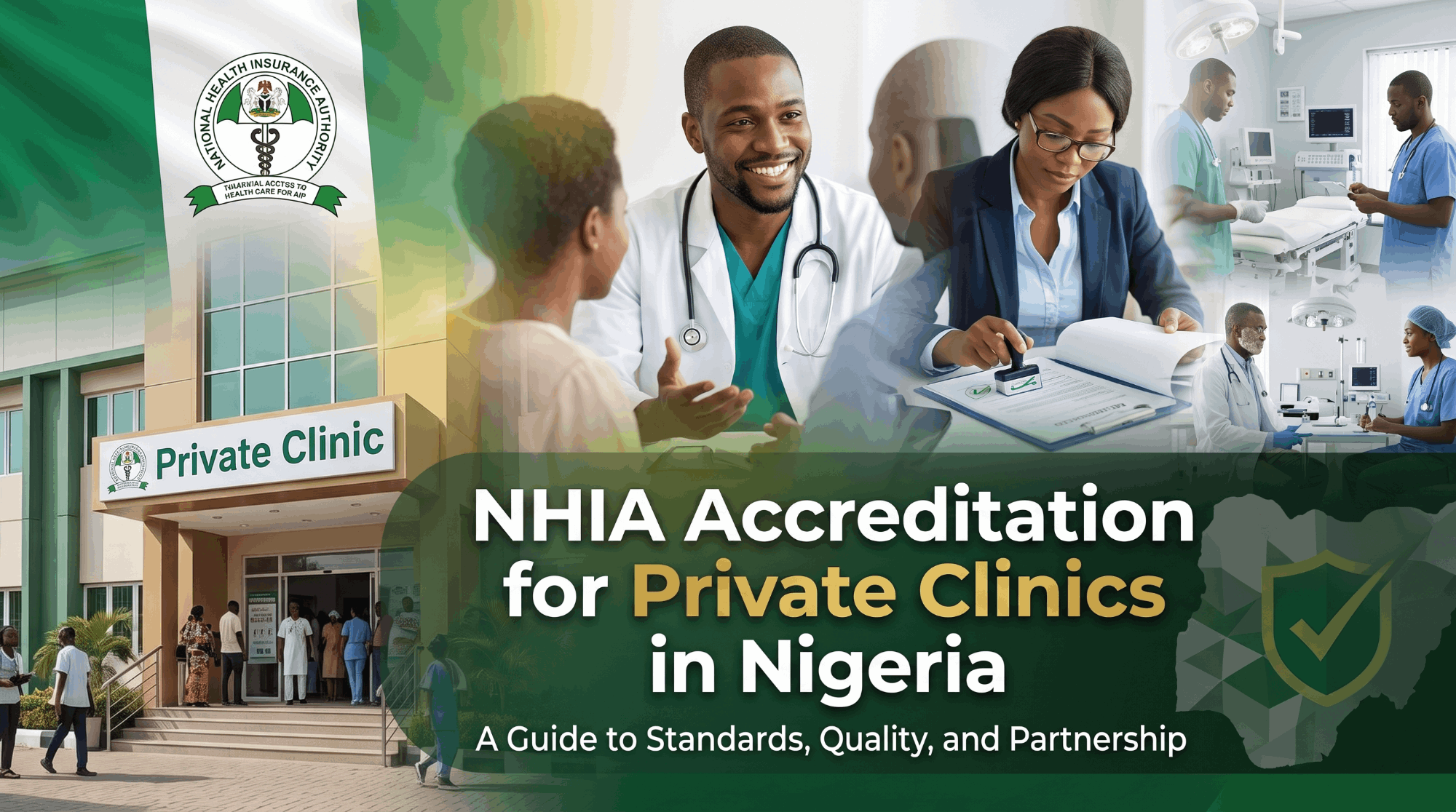
NHIA accreditation is the licence that lets a private clinic in Nigeria treat insured patients and bill a payer for the visit. The National Health Insurance Authority accredits each facility for two years, charges a one-off fee of ₦60,000 per service, and lists the facility so that Health Maintenance Organisations (HMOs) can send it enrollees. Accreditation alone does not bring patients. Your clinic also needs a contract with at least one HMO, or empanelment with your state health insurance agency, and a billing system that can track HMO claims and capitation. This guide covers all three payers, the documents, the fees and the payment timelines.
NHIA accreditation at a glance
| Question | Answer |
| Who accredits private clinics for insurance? | The National Health Insurance Authority (NHIA), under section 36 of the NHIA Act 2022 |
| Law behind it | National Health Insurance Authority Act, 2022 (Act No. 17 of 2022, gazetted 24 May 2022). It repealed the NHIS Act and made health insurance mandatory for every resident |
| Facility categories | Primary, secondary and tertiary healthcare facilities |
| Accreditation fee | ₦60,000 per service, non-refundable. “Service” means primary care and each secondary specialty |
| Re-accreditation fee | ₦50,000 for primary and secondary providers after two years |
| Validity | Two years |
| Where to pay | Remita, to the Federal Government of Nigeria, MDA: National Health Insurance Authority |
| Who pays the clinic | HMOs (NHIA programmes and private plans), state health insurance agencies, and NHIA-appointed Third Party Administrators (TPAs) for some programmes |
| Capitation rate | ₦750 per enrollee for 12 years, raised to ₦1,450 in 2025 |
| Pre-authorisation code | HMOs must issue it within one hour, from 1 April 2025 |
| Enrolment | 21.73 million people at the end of 2025, below 10 percent of the population |
Sources: NHIA stepwise accreditation procedure, NHIA Act 2022, Peoples Gazette, 5 September 2025, Nairametrics, 2 July 2026.
How can a private clinic accept insurance in Nigeria?
A private clinic accepts insurance in Nigeria by getting NHIA accreditation, then signing with the payers that cover its patients: HMOs, the state health insurance agency, or both. There is no single contract that covers every insured patient. You deal with three kinds of payer, and each one pays differently.
The three payers and how they pay
| Payer | Who they are | Who pays your clinic | How they pay | What the law says |
| NHIA programmes | Federal civil servants, the organised private sector, students, the informal sector (GIFSHIP), and the Vulnerable Group Fund | An NHIA-accredited HMO, or a TPA for programmes such as CEmONC | Capitation for primary care, fee-for-service for referred care | Section 36 of the NHIA Act: an accredited provider renders care “in consideration for a capitation payment” and “for payment of approved fee for service” |
| State health insurance schemes | Residents of each state, run by a state agency such as LASHMA in Lagos | The state agency, or an HMO or TPA it appoints | Capitation and fee-for-service set by the state | Section 13 of the Act requires every state to run a scheme; section 14 makes enrolment mandatory |
| HMOs (private plans) | Companies accredited by NHIA to manage care for employers and individuals | The HMO itself | A tariff agreed in your provider agreement, usually capitation plus fee-for-service | Section 34 of the Act obliges an HMO to “pay for services rendered by health care providers accredited under the Authority” |
The HMO is the main route for most private clinics. By the end of 2025, HMOs covered 2.17 million enrollees nationwide, and 1.18 million of them lived in Lagos (Nairametrics, 2 July 2026, reporting NHIA data). NHIA listed 84 accredited HMOs in October 2024 (Nairametrics, 28 October 2024).
Why insurance matters more now
The NHIA Act 2022 changed the rules. Section 14 says “every person resident in Nigeria shall be required to obtain health insurance”, and it names employers with five staff and above, informal sector workers and all other residents. Lagos went further. The state issued an Executive Order on 16 July 2024 that made enrolment compulsory for every resident, employer and worker (KPMG Nigeria, August 2024), and in January 2026 it named the Commissioner for Health as enforcement lead (Radio Nigeria Lagos, 30 January 2026).
Coverage is still low, at 21.73 million people at the end of 2025, but enrolment grew by 2.4 million in 2024 alone, the highest on record (BusinessDay, 25 October 2025). A clinic that cannot bill a payer will lose those patients to one that can. If you are still setting up, start with our guide to opening a clinic in Nigeria.
NHIA accreditation categories, fees and validity
NHIA accreditation covers three facility categories: primary, secondary and tertiary. The NHIA Operational Guidelines 2023 set out the classification, the facility and personnel requirements for each level, the accreditation procedure and the conditions for renewal in section 3.1. The Act leaves the detail to those guidelines. Section 36(1) says accreditation “shall be in such form and manner that complies with the operational guidelines of the Authority”.
A private GP clinic is a primary healthcare facility. It earns capitation for its registered enrollees and refers what it cannot handle. A clinic with a specialist, a theatre or an inpatient unit can apply as a secondary provider for each specialty, and each specialty is a separate “service” for the fee.
NHIA accreditation fees
| Item | Amount | Notes |
| Accreditation, per service | ₦60,000 | Non-refundable. Primary care is one service. Each secondary specialty is another |
| Re-accreditation, primary and secondary | ₦50,000 | Paid after two years, if the facility still meets NHIA requirements |
| Validity | 2 years | Codes come by email or phone; certificates come through the NHIA state office |
| Payment channel | Remita | Bank branch, internet banking or remita.net. Revenue type: IGR, Accreditation Fee |
| Missed re-accreditation deadline | Loss of accreditation | The deadline is printed on the facility’s re-accreditation letter |
Source: NHIA stepwise procedure for payment of accreditation fees. The document is undated, so confirm the current NHIA accreditation fee with your state office before you pay. [NOT CONFIRMED: whether NHIA revised the ₦60,000 and ₦50,000 fees after the 2025 tariff review.]
Standards are rising. NHIA has moved accreditation on to digital quality assessment tools, pilots them nationwide, and ranks facilities on quality scores. Facilities that fail the staffing, equipment and infrastructure requirements “are not accredited or re-accredited to provide services to health insurers” (Mondaq, 5 November 2025). State offices run re-accreditation visits with the state agency, checking service delivery, infrastructure, staffing, essential drugs, record keeping and financial accountability (Borno State Contributory Healthcare Management Agency, 14 September 2025).
Documents for insurance empanelment in Nigeria
The documents for insurance empanelment in Nigeria start with your state facility registration and your company papers, then add professional licences, tax and bank records. NHIA issues its own application form after it receives your letter and fee receipt, and asks for “all necessary documents” to be attached. HMOs and state agencies ask for a similar set. Prepare one scanned pack and reuse it.
| Document | Why a payer asks for it | Where to get it |
| Application letter on the clinic’s letterhead | NHIA requires a letter to the Director General stating the services you want to render | Your clinic |
| NHIA fee receipt | The receipt is attached to the letter before NHIA issues the application form | NHIA headquarters, zonal or state office, after the Remita payment |
| State facility registration or licence | Proves the clinic is a lawful health facility. In Lagos this is the HEFAMAA certificate of operation | State Ministry of Health or its agency. In Lagos, the HEFAMAA portal |
| CAC certificate of incorporation or business name | Shows the legal owner that will sign the provider agreement and receive payment | Corporate Affairs Commission |
| Practising licences for every doctor, nurse and pharmacist | NHIA sets requirements for healthcare professionals in section 3.1.2 of its guidelines. HMOs credential each clinician | MDCN, NMCN, PCN and other councils |
| Staff list with qualifications | Accreditation visits check manpower against the facility category | Your clinic |
| Current tax clearance certificate | Required for HEFAMAA registration and asked for by payers before they pay you | FIRS or the state internal revenue service |
| Bank account details and a bank letter | HMOs cannot pay without them. In the FCT, HMOs blamed missing hospital bank details for unpaid claims | Your bank |
| Equipment and infrastructure list | Checked against the facility and personnel requirements for your category | Your clinic |
| Medical waste and environmental certificates | Required by HEFAMAA (LAWMA medical certificate) and checked at inspection | LAWMA in Lagos, or the state equivalent |
| Health records clearance | HEFAMAA asks for an HMIS clearance before it registers a facility | Lagos State Ministry of Health, HMIS unit |
Sources: NHIA stepwise procedure, HEFAMAA quick guide for new facilities, Voice of Nigeria, 29 July 2025. [NOT CONFIRMED: the exact document list on the NHIA application form. NHIA issues the form only after it receives the application letter and fee receipt, and the form is not published online.]
Keep your patient records in order before the inspection. NHIA’s claims rules require “accurate and verifiable patient records” with the patient’s National Identification Number, diagnosis, treatment, an itemised list of services, and dates of admission and discharge (NHIA claims SOP). Our guide to Nigerian healthcare regulations for clinics covers the record-keeping and data protection duties that sit behind this.
How to get NHIA accreditation: step by step
NHIA publishes the procedure as a ten-point document under the Treasury Single Account rules (NHIA stepwise procedure). Here is what it means in practice.
- Decide which services you will register. Primary care is one service. Each secondary specialty is another, with its own ₦60,000 fee. Register only what your licence, staff and equipment can support.
- Write the application letter. Put it on the clinic’s letterhead, address it to the Director General and CEO of NHIA, and state the services you want to render.
- Pay the fee on Remita. Select Federal Government of Nigeria, then National Health Insurance Authority. Revenue type is “IGR, Accreditation Fee”. Use the clinic’s name exactly as it appears on the letter, and an email address, because the electronic receipt goes there.
- Convert the receipt. Take the Remita receipt or bank slip to NHIA headquarters or any zonal or state office and collect an official NHIA receipt.
- Submit the letter and receipt. NHIA then issues its application form. Fill it in and attach every supporting document from the checklist above.
- Prepare for the accreditation visit. NHIA schedules an inspection for every prospective facility. Inspectors check staffing, equipment, infrastructure, records and drugs against the requirements for your category.
- Receive your accreditation code. If you pass, NHIA generates a code and sends it to the clinic’s email or phone. The certificate carrying that code comes through your NHIA state office and is released only to an identified representative.
- Diary the renewal. Accreditation lasts two years. The re-accreditation fee for primary and secondary providers is ₦50,000, and missing the date on the re-accreditation letter forfeits your status.
- Sign with payers. Accreditation lists you. Patients arrive once an HMO or state agency contracts you and registers enrollees to your clinic.
[NOT CONFIRMED: how long NHIA takes from application to accreditation visit and code. NHIA does not publish a service timeline for facility accreditation.]
HMO empanelment: contracts, capitation and fee-for-service
HMO empanelment is a commercial agreement between your clinic and each HMO, built on top of your NHIA accreditation. An HMO is “a company accredited by the NHIA to manage the provision of health care services to beneficiaries by accredited healthcare facilities” (NHIA Operational Guidelines 2023, definitions). HMOs pay NHIA ₦1,000,000 for provisional accreditation, and their accreditation also lasts two years (NHIA procedure for HMO accreditation).
What an HMO checks before it signs
NHIA approves the format of HMO contracts with facilities, and the capitation and other payments HMOs owe to facilities, under section 3(t) and 3(u) of the NHIA Act. Section 3.3.21 of the Operational Guidelines covers the agreement between HMOs and facilities. Within that frame, each HMO credentials your clinic. Expect to supply your NHIA accreditation code, facility registration, each clinician’s licence, your service list, your price list for services outside the NHIA tariff, bank details and a signed provider agreement. Many HMOs also run their own site visit. Sign with the HMOs that cover employers near your clinic.
Capitation versus fee-for-service
| Capitation | Fee-for-service | |
| What it is | A fixed payment per enrollee registered to your clinic, paid “regularly and in advance irrespective of whether the enrollee utilises the service or not” | Payment “for completed health care services, not included in the capitation fees”, after a referral or for emergencies |
| Who earns it | Primary care providers | Secondary and tertiary providers, and primary facilities for emergency cases |
| Rate | ₦750 per enrollee for 12 years, raised to ₦1,200 in July 2024, then to ₦1,450 under the 2025 review | Set by the NHIA price list. The October 2021 list, still the version on the NHIA site, prices a specialist initial consultation at ₦2,000, a normal delivery at ₦10,000 and a caesarean section at ₦70,000. Rates rose 40 percent in July 2024 and 378 percent from April 2025 |
| Cash flow | Predictable. Falls if enrollees move to another clinic | Lumpy. Needs a pre-authorisation code and a clean claim for every item |
| Risk to your clinic | High-use enrollees cost more than they bring in | Rejected or delayed claims |
Sources: NHIA Act 2022 definitions, NHIA Professional Fee-for-Service Price List, October 2021, BusinessDay, 4 July 2024, Nairametrics, 4 February 2025, Peoples Gazette, 5 September 2025.
The 2024 and 2025 tariff revisions
Private providers forced the change. In May 2024, the Association of Nigerian Private Medical Practitioners threatened to withdraw from the scheme over a ₦750 capitation rate that had not moved in 12 years. On 4 July 2024, after a stakeholders’ meeting in Abuja, NHIA raised capitation by 60 percent and fee-for-service by 40 percent, with immediate effect and pending an actuarial study (BusinessDay, 4 July 2024; Daily Trust, 9 July 2024).
On 3 February 2025, NHIA Director General Dr Kelechi Ohiri announced the results of that study: capitation up 93 percent on the December 2023 rate and fee-for-service up 378 percent on 2023 rates, approved by the Coordinating Minister of Health and effective April 2025 (Nairametrics, 4 February 2025). The minister later put the new capitation at ₦1,450 per person, against the old ₦750 (BusinessDay, 25 October 2025). NHIA said the 2025 rates are a stabilising measure until a full actuarial review sets sustainable ones, so expect another revision.
[NOT CONFIRMED: the period for the ₦1,450 capitation rate (per enrollee per month is the long-standing NHIS basis, but the 2025 announcements say only “per person” or “per registered life”), and the revised 2025 fee-for-service schedule, which NHIA had not published on its website by 19 October 2026. Ask your NHIA state office or HMO for the current tariff circular.]
State schemes: ILERA EKO and other state agencies
Every state must run a health insurance scheme under section 13 of the NHIA Act, and the state agency accredits or empanels its own providers, often with the NHIA state office. The biggest for private clinics is Lagos.
Lagos: LASHMA and ILERA EKO
The Lagos State Health Management Agency (LASHMA) runs ILERA EKO under the Lagos State Health Scheme Law 2015. Enrolment became compulsory on 16 July 2024 by Executive Order (KPMG Nigeria, August 2024). The standard plan costs ₦15,000 a year for an individual, ₦55,000 for a family of four and ₦80,000 for a family of six, and an Equity Fund, funded by 1 percent of the state’s consolidated revenue, covers more than 300,000 vulnerable residents (News Agency of Nigeria, 3 June 2025). Lagos had 2.76 million insured residents at the end of 2025, second only to Delta (Nairametrics, 2 July 2026).
What LASHMA expects from an empanelled facility is public. In March 2026 it started a statewide readiness assessment of ILERA EKO hospitals, including high-traffic private hospitals. Facilities must have a designated ILERA EKO desk officer, screening tools to identify vulnerable patients, clear signage, a complaints procedure and working systems to enrol unregistered residents (Radio Nigeria Lagos, 28 March 2026). LASHMA has sanctioned providers before for withholding drugs, refusing admissions and charging enrollees for covered care (The Guardian Nigeria, 26 September 2022).
[NOT CONFIRMED: LASHMA’s provider application steps, empanelment fee and payment timeline. The LASHMA and ILERA EKO websites could not be opened on 19 October 2026. Contact LASHMA at Alausa, Ikeja, for the current provider pack.]
Other states
Kano, Kaduna, Oyo, Delta and the FCT each had more than 670,000 enrollees at the end of 2025 (Nairametrics, 2 July 2026). Each state agency sets its own provider requirements. In the FCT, the annual premium is ₦22,500, and the administration had to clear about ₦4 billion in capitation and fee-for-service arrears owed to providers for 2022 to 2024 (Voice of Nigeria, 29 July 2025). State schemes also channel the Basic Health Care Provision Fund (BHCPF) to designated primary facilities through the state agencies and NHIA (NHIA, 6 May 2024). Ask your state agency whether private primary facilities can join its BHCPF list.
For a sense of how other markets handle the same step, see how Kenya moved to a single national contract in our guide to starting a clinic in Kenya.
How long do insurance claims take to pay clinics in Nigeria?
Insurance claims in Nigeria should pay within the period set in the NHIA Operational Guidelines, and an HMO that misses it commits an offence under section 48 of the NHIA Act. In practice, capitation arrives monthly in advance when the HMO is paying on time, fee-for-service claims take weeks to months, and arrears of a year or more have happened in the FCT. The one firm number NHIA has published is for its CEmONC programme, where the TPA must pay verified claims within 14 days.
What the rules say
- Capitation is paid in advance. The Act defines capitation as a payment made “regularly and in advance”, whether or not the enrollee uses the service (NHIA Act 2022).
- Late payment is an offence. Section 48(1) makes it an offence for a person or HMO to fail “to remit payments to Health Care Providers within the specified period indicated in the operational guidelines” or to fail “to settle fee-for-service or other claims from the Health Care Providers within the stipulated time”. Section 49 keeps NHIA’s power to sanction HMOs and providers under the guidelines.
- Pre-authorisation in one hour. From 1 April 2025, HMOs must issue a treatment authorisation code within one hour of a request. If the code does not come, the facility proceeds with treatment and escalates to the NHIA state office (News Agency of Nigeria, 2 September 2025; Nairametrics, 4 May 2025).
- CEmONC: weekly claims, 14-day payment. Facilities submit claims weekly to the assigned TPA, with a cover letter signed by the medical director, copying NHIA. NHIA front-loads TPAs with funds, and the TPA “disburses funds to facility within 14 days for verified claims”. Disputes go to NHIA, which rules within one month (NHIA claims SOP).
[NOT CONFIRMED: the number of days in section 2.13.5 of the NHIA Operational Guidelines 2023, “Timeline for Claims Management by NHIA, SSHIAs and TPA”. The copy on the NHIA website contains only the table of contents. Request the full section from your NHIA state office.]
The claims journey and what goes wrong
| Stage | What should happen | What goes wrong |
| 1. Verify the enrollee | Check the HMO ID card or app, the enrollee’s status and the plan’s benefit limits before care | Expired cover, a dependant not on the plan, or a service outside the benefit package |
| 2. Treat and record | Record diagnosis, services, drugs and dates. NHIA claims need the patient’s NIN | Missing NIN, no diagnosis code, drugs outside the NHIA medicines list |
| 3. Get the authorisation code | For referrals and fee-for-service items, request the code and note the time. HMOs have one hour | Code requested after treatment, or no record of the request time, so the HMO disputes the claim |
| 4. Submit the claim | Send the itemised claim and the code within the HMO’s window. CEmONC claims go weekly | Late batches, items priced off the wrong tariff, or claims sent without a signed cover letter |
| 5. HMO review | The HMO vets the claim and issues payment advice with reasons for any rejection | Partial payments with no reasons, so your team cannot appeal or correct |
| 6. Payment | Capitation in advance; fee-for-service within the guideline period | Delayed reconciliation. In 2024, NHIA sanctioned 47 HMOs for late codes and untimely payment reconciliation |
| 7. Reconcile | Match the payment advice to each claim, chase short payments, appeal rejections | No one owns reconciliation, so short payments are written off |
Insurance claims in Nigeria fail most often at stages 3 and 5, so track every claim from stage 3 to stage 7 in one place. See how insurance billing and claims tracking works inside a clinic system.
Sanctions on HMOs and providers
NHIA enforces both ways. In its 2024 complaints report, published in June 2025, NHIA investigated 3,507 complaints and sanctioned 49 facilities and 47 HMOs. Facilities were cited for denying service, unavailable medicines and charging enrollees for covered care: 84 warning letters, four suspensions, six delistings, and refunds of ₦4,375,500 to 54 enrollees. HMOs were cited for delayed authorisation codes, untimely payment reconciliation and poor oversight: 35 warning letters and refunds of ₦748,200 (Voice of Nigeria, 29 June 2025). NHIA’s enforcement team also runs unannounced checks on the one-hour rule, and found 70 percent compliance at National Hospital Abuja in May 2025 (Peoples Gazette, 3 May 2025).
Running an activity under a name such as “health scheme” or “health maintenance organisation” without NHIA registration carries a fine of at least ₦2,000,000, imprisonment of at least five years, or both, under section 22 of the Act. Section 47 sends disputes between HMOs and providers to NHIA for mediation first, then arbitration.
Plan for the gap. The FCT arrears ran from 2022 to 2024 before the administration cleared them. A clinic that depends on fee-for-service from a few HMOs should hold two to three months of operating costs in reserve and know, each month, which HMO owes what.
Common mistakes
- Treating NHIA accreditation as the finish line. Accreditation lists you. Patients come from HMO and state agency contracts. Apply for both in the same quarter.
- Registering too many services. Each specialty costs ₦60,000 and brings an inspection against secondary-level requirements. Register what you can staff and equip now.
- Letting re-accreditation lapse. The deadline is on the letter, and missing it forfeits your status. Put the two-year date in a shared calendar on the day you receive the certificate.
- Signing with every HMO. An HMO with no enrollees near you adds credentialing work and no revenue. Ask how many lives it has near your clinic before you sign.
- Not recording the time of a code request. The one-hour rule only protects you if your record shows when you asked. Log the request and the response in the patient’s visit.
- Billing from an old tariff. Fee-for-service rates changed in July 2024 and April 2025. Load the current tariff for each payer into your billing system and date it.
- Missing the NIN. NHIA claims require the enrollee’s National Identification Number. Capture it at registration, not at claim time.
- No owner for reconciliation. Short payments go unnoticed when nobody matches payment advice to claims. Give one person the job and review it monthly.
- Charging enrollees for covered care. This was the leading reason NHIA sanctioned facilities in 2024, and LASHMA sanctions for it too. Train the front desk on each plan’s benefit package.
How Easy Clinic fits in
NHIA accreditation gets your clinic listed, and clean claims keep it paid. Both depend on the same records NHIA inspects: verified enrollees, complete visit notes, the right tariff and a claim sent on time. Easy Clinic lets you set up each payer with its own billing rates, contract terms and coverage rules, validates each claim against that coverage, and generates invoices from the payer’s rules, as described on the insurance billing and claims page. Its EMR software for Nigeria lists HMO claims and reconciliation and capitation and fee-for-service billing among its features. [CONFIRM WITH EASY CLINIC: any NHIA, state scheme or HMO claims integration, and any named Nigerian clients.] Compare it with other options in our review of the best clinic management software in Nigeria, or see Easy Clinic pricing.
Related guides
- How to open a clinic in Nigeria
- Nigerian healthcare regulations every clinic must follow
- The complete guide to starting a clinic in Kenya
- How to open a clinic in Uganda
- How to open a clinic in Rwanda
- How to open a clinic in Ethiopia
NHIA accreditation: common questions
What is NHIA accreditation?
NHIA accreditation is the National Health Insurance Authority’s approval of a healthcare facility to treat insured patients under section 36 of the NHIA Act 2022. It is valid for two years and gives the facility a code that HMOs and state schemes use to register enrollees to it.
How much does NHIA accreditation cost?
The NHIA accreditation fee is ₦60,000 per service, non-refundable, paid through Remita. Primary care is one service and each secondary specialty is another. Re-accreditation for primary and secondary providers costs ₦50,000 after two years.
How long is NHIA accreditation valid?
Two years. The re-accreditation deadline is printed on the facility’s re-accreditation letter, and missing it forfeits the accreditation.
Can a private clinic accept insurance in Nigeria without NHIA accreditation?
Not under the NHIA framework. HMOs are obliged by section 34 of the Act to pay for services rendered by providers accredited under the Authority, so they contract accredited facilities. State schemes run their own empanelment, often alongside the NHIA state office.
What is the difference between NHIA accreditation and HMO empanelment?
NHIA accreditation is the regulatory approval. HMO empanelment is the commercial contract with each HMO that sends you enrollees and pays you. You need the first to get the second.
How much is capitation in Nigeria?
The long-standing rate was ₦750 per enrollee. NHIA raised it by 60 percent in July 2024, then by 93 percent on the December 2023 rate from April 2025, which the Coordinating Minister of Health put at ₦1,450 per person in 2025.
How long do insurance claims take to pay clinics in Nigeria?
For insurance claims in Nigeria, capitation is paid in advance, and the NHIA Operational Guidelines set the period for fee-for-service payment, which an HMO commits an offence by missing. Under NHIA’s CEmONC programme, the TPA pays verified claims within 14 days. Delays beyond these timelines are common, and NHIA sanctioned 47 HMOs in 2024 for late codes and untimely reconciliation.
How fast must an HMO issue an authorisation code?
Within one hour of the request, under an NHIA policy that took effect on 1 April 2025. If the code does not come, the facility proceeds with treatment and escalates to the NHIA state office.
Does a Lagos clinic need HEFAMAA registration before NHIA accreditation?
Yes. HEFAMAA registration is the state licence to operate a health facility in Lagos, and NHIA and HMOs ask for proof of state registration. HEFAMAA requires a letter of intent, the CAC certificate, a current tax clearance certificate, a LAWMA medical certificate, an HMIS clearance and credentials for every professional.
Can NHIA delist my clinic?
Yes. In its 2024 complaints report NHIA suspended four facilities and delisted six for denying service, unavailable medicines and charging enrollees for covered care.
Is health insurance mandatory in Nigeria?
Yes. Section 14 of the NHIA Act 2022 requires every resident to obtain health insurance, including employers with five or more staff and informal sector workers. Lagos enforces this through an Executive Order issued on 16 July 2024.
Does NHIA accreditation cover state schemes like ILERA EKO?
No. Each state agency empanels its own providers under its state law. LASHMA assesses ILERA EKO facilities for a desk officer, vulnerable patient screening, signage and a complaints procedure.
This guide is general information, not legal or tax advice. Confirm current rules with the National Health Insurance Authority and your state health insurance agency.